
The government has been urging the public to keep emergency supplies of food, water and cash at home in case of extreme weather, cyber-attacks and war.
 Now,
Now, The government advises that all households should maintain a first aid kit packed with key items including:
- Waterproof plasters
- Bandages
- Thermometer
- Antiseptic
- Eyewash solution
- Sterile dressings and gloves
- Medical tape for dressings
- Tweezers
- Painkillers, such as paracetamol
Dr Umer Malik, a private GP in Wimbledon, has provided some additional advice on how households can be prepared for an emergency, including considering medications and planning ahead.
Be organised when it comes to medication and first aid essentials
He says that being organised is more important than stockpiling, explaining:
“Emergency preparation isn’t about turning your house into a bunker. It’s about removing the avoidable problems that become much harder to solve when normal services aren’t working.
“The answer isn’t panic buying or building a stockpile; it’s reordering when you have a week or ten days left rather than two. That one habit is worth more than anything you could put in a box.”
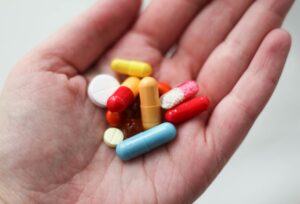 Though efficient, the move to digital-first approaches on the NHS means that a cyber-attack or prolonged power cut could disrupt supplies of prescription medication.
Dr Malik highlights the fact that repeat prescriptions are typically ordered through the NHS app, GP practices and pharmacies hold medication records electronically and the NHS 111 emergency prescription service also runs on electronic prescribing.
This means that records could become inaccessible, and Dr Malik therefore recommends keeping a hard copy of your prescription somewhere safe. This should include the name, strength, dose and timing of your medication.
He said:
“In an emergency, knowing exactly what someone takes can be almost as important as having the medicine itself.”
He also advised that if people run out of a prescription medication and are unable to reach a GP, a pharmacist may be able to provide them with an emergency supply.
However, this is simply “a safety net,” and not an emergency plan and he warns that some medicines, such as controlled drugs, insulin and inhalers, do have specific restrictions.
Store medication and first aid essentials correctly
As well as knowing what and how much you take and when, patients should also ensure they know how to store their medication correctly.
For example, a power cut presents issues for medication that needs to be kept in the fridge.
Dr Malik explains:
“Storage limits vary by product, so the preparation is to read your own leaflet now rather than work it out in the dark. The same goes for anything relying on powered medical equipment.”
In addition to the usual list for a first aid kit, Dr Malik also advises including oral rehydration sachets in yours. These can be bought over-the-counter from a pharmacy, but can be important when it comes to preventing some illnesses from spiralling out of control.
He explains, for example, that dehydration is what turns a minor bout of vomiting and diarrhoea “from unpleasant into dangerous in young children and older adults.”
Learn about first aid essentials
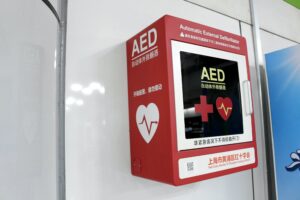 Knowing some basic first aid principles and techniques is probably also helpful for emergency situations, when emergency services may be under increased pressure and medical help may not be close at hand.
A life-saving automatic external defibrillator (AED) can also be key. Defibrillators can be used by anyone, without training, to help someone who is not in hospital but whose heart has stopped or is beating abnormally.
There are many community defibrillators located across the UK. One way to prepare yourself for an emergency is to ensure you know where your nearest defibrillator is located, and whether this is publicly accessible 24 hours a day.
You can check the location of your nearest defibrillator online.
If you are a defibrillator guardian, make sure you register it online with the National Defibrillator Network.
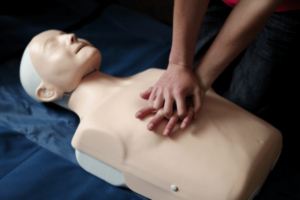
It’s worth ensuring you are familiar with the key principles of cardiopulmonary resuscitation (CPR) and the use of a defibrillator so that you can act in an emergency. Download First Response Training’s free guide How to Respond to an Emergency for essential advice and guidance.
First aid training and support
 First Response Training is a leading national training provider.
They deliver a wide range of training in health, safety, first aid, fire safety, food safety, health and social care, mental health and welfare and other special focus topics for all industry sectors.
They have almost 30 years’ experience in delivering first class first aid training services, including First Aid at Work, Emergency First Aid at Work, Paediatric First Aid and Basic Life Support courses, all of which include training in the use of automated external defibrillators.
A trainer from FRT says:
“Extreme weather is becoming more likely and more dangerous. When you also consider increased risks of war, cyber-attacks and other emergencies, it is clear that we need to be prepared and organised – while remaining sensible and not panic buying.
“A key way of making sure you’re equipped for an emergency is to ensure you have a fully stocked first aid kit, you are organised and knowledgeable about any medication you take, and you are familiar with the correct way to respond to a first aid emergency. This includes knowing where your nearest life-saving AED is located and understanding how to carry out CPR on an individual in need.
“It’s vitally important for as many people as possible to learn essential life-saving skills and other first aid techniques so that they can act quickly and help people in an emergency. First aid training really is so valuable.”
For more information on the training that FRT can provide, please call them today on freephone 0800 310 2300 or send an e-mail to info@firstresponsetraining.com.