The Care Quality Commission (CQC) is developing new guidance on what good dementia care should look like, and they are seeking the views of people providing and using services, their families, carers and the general public.
 The health and social care watchdog is planning to launch a formal consultation early next year, but, prior to this, they are operating a public survey to help shape the guidance before they begin to write it.
It is hoped that the new guidance, when it is finalised, will improve people’s experiences of dementia care and their outcomes from care. This includes improved experiences for people living with dementia as well as their carers and families.
The guidance will also:
- Describe what good dementia care looks like
- Support health and adult social care providers to deliver high-quality care
- Promote consistency across services
- Protect and promote people’s rights
It will form part of the CQC’s Dementia Strategy and will become statutory guidance, meaning that all CQC-registered care providers will have to follow it.
Help establish dementia care that treats people with dignity
 The watchdog says it wants the guidance to establish a “clear, shared understanding of what people living with dementia should be able to expect from care services, and what good dementia care looks like in practice.”
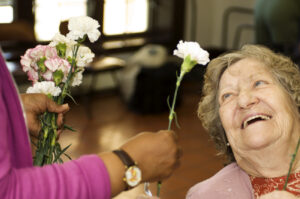
They say that every person should be able to expect care and support that treats them as an individual person. This includes “recognising what matters most to them, and responding to their needs with dignity, compassion and understanding.”
The CQC is urging both individuals and organisations who have knowledge, experience or an interest in dementia care and support to respond to their survey.
It has just 4 questions, and all responses must be completed and submitted by 5pm on 30th October 2026.
You can access the survey here.
September is World Alzheimer’s Month
 The survey has been launched during World Alzheimer’s Month, which is celebrated every September, with World Alzheimer’s Day marked on 21st September.
The Alzheimer’s Society says it will “take a society to beat dementia.”
The leading UK charity highlights the following statistics to raise awareness and understanding during World Alzheimer’s Month:
- Dementia is the UK’s biggest killer
- Every 3 minutes, someone in the UK develops dementia
- 1 in 3 people born in the UK today will go on to develop dementia in their lifetime
The Alzheimer’s Society wants people to help them in the fight against dementia by donating money to fund vital research, volunteering time to help support project for people impacted by dementia, campaign to improve experiences for individuals, or become a Dementia Friend.
The charity’s message is clear and hard-hitting:
“The impact of dementia is enormous – it affects us all, it devastates lives, overwhelms the health and social care system, and the economy.
“At Alzheimer’s Society we’re leading the way to create a future where dementia no longer devastates lives, bringing together people from all the spheres of life it touches.
“Help us beat dementia this World Alzheimer’s Month.”
Improve dementia care and support with training
 First Response Training (FRT) is a leading, national training provider. They deliver over 7,000 courses each year in the fields of health and safety, first aid, fire safety, food safety, mental health, health and social care and other special focus topics.
Their diverse portfolio includes training awards specially designed for health and social care workers, such as Dementia Awareness, Safeguarding Adults, Equality, Diversity and Inclusion, Person Centred Care and Support, Dignity in Care and many others.
Their course portfolio spans Care Certificate standards, mandatory training awards, clinical skills, special focus courses and training for supervisors and managers.
A Trainer at FRT, says:
“Around 900,000 people in the UK are affected by dementia and researchers anticipate that this will increase to 1.6 million people by 2040.
“There is currently no cure for the disease but there are treatments available to help manage symptoms and lots of specialist support for people and their families.
“Early dementia diagnosis is key to enable individuals to make preparations for their future, and because starting treatments as soon as possible can help to slow deterioration over time. It also enables family and friends to access support and helpful resources.
“Training in dementia awareness is key for all individuals working in health and social care and can help ensure that care provided for people is safe, effective, compassionate, person-centred and dignified.”
Key signs and symptoms of dementia can include:
- Memory loss
- Disorientation
- Poor concentration
- Mood changes
- Self-neglect
- Weight loss
- Perception changes
- Sensory loss
- Depression
- Incontinence
- Behavioural changes
- Repetitive behaviours
- Communication difficulties
For more information on the training provided by FRT, please call them on freephone 0800 310 2300 or send an e-mail to info@firstresponsetraining.com.