It’s Neurodiversity Celebration Week (16th – 20th March 2026), which celebrates different minds and challenges the negative stereotypes and misconceptions surrounding neurological differences.
 Neurodiversity Celebration Week is a global initiative founded in the UK in 2018 by Siena Castellon MBE, who has campaigned to support young people with special educational needs (SEN) from a young age.
The multi-award-winning autism advocate and anti-bullying campaigner, who is herself diagnosed with autism, dyslexia, dyspraxia and ADHD, founded the annual awareness week to help create more inclusive and equitable cultures, celebrate different minds and empower individuals.
The campaign aims to transform public perceptions of neurodiversity and improve support for neurodiverse individuals in education spaces, workplaces, and across society.
Free resources and events are provided for parents, schools, universities, workplaces and other organisations to help them participate in Neurodiversity Celebration Week and recognise and highlight the strengths and talents of neurodiverse individuals.
Neurodiversity Celebration Week 2026 is a call to action
There are two new additions for Neurodiversity Celebration Week 2026:
- Members of the neurodiversity community are invited to host their own webinar, leading conversations on the topics that matter most to them. Webinars could focus on sharing lived experiences, highlighting research or exploring solutions to challenges experienced within the community. Practical toolkits are available for parents, schools and employers to help them host webinars or panel discussions and expand the impact of Neurodiversity Celebration Week.
- The focus of the week is moving beyond simply raising awareness, to taking positive action. This expansion of focus is supported by a webinar series that specifically looks at making organisational change happen. The series will showcase best practice in leadership, systems change and scaling inclusion across workplaces, schools and communities to create sustained impact. It is hoped it will inspire people to take action
The campaign organisers highlight the following key information to remember this Neurodiversity Celebration Week and beyond:
- Each neurodivergent individual has their own profile – no two people are the same
- Each neurodivergent individual has their own unique pattern of strengths, talents and challenges
- It is important to take a person-centred approach, tailoring support strategies to the individual concerned
- It is also important to focus on harnessing the strengths and talents of neurodivergent individuals to help build confidence and self-esteem and enable people to “flourish in their day-to-day”. This will also help build lasting change
Founder Siena Castellon MBE explains that Neurodiversity Celebration Week was primarily founded to “change the narrative” around neurodiversity and “create a balanced view which focuses equally on our talents and strengths.”
Supporting Neurodiversity Celebration Week
 Universities, NHS Trusts, local authorities, charities and many other organisations across the UK are supporting Neurodiversity Celebration Week 2026.
Inclusive Employers supports the annual awareness campaign, highlighting how neurodivergent individuals face “unique challenges” in the world of work.
They cite a recent report from the Office for National Statistics which revealed that autistic people have the lowest employment rates of any disability group, with just over a fifth (21.7%) of autistic people currently in employment.
This is despite the fact that approximately 77% of unemployed autistic people want to be in work. In addition, many autistic people who are employed are fulfilling roles below their skill level, are on zero-hour contracts or in temporary positions, according to Autistica, the UK’s leading autism research charity.
Autistica estimates that 3 in 10 autistic people are in employment, but say that 3 in 4 would like to be. The explain that autistic people face numerous barriers to employment, including:
- Non-inclusive recruitment practices, which focus on social skills, can include vague job descriptions, complex application processes and ambiguous interview questions
- Sensory overwhelm in open-plan office environments
- Stigma and misunderstanding as a result of a lack of awareness and knowledge from employers and colleagues
- Low expectations which hinder career progression
- Lack of suitable support and reasonable adjustments. This can cause many autistic people in employment to ‘mask’, which in turn can lead to burnout
- Many struggle with mental health and wellbeing at work due to these other challenges, and this can serve to further widen the employment gap
A strengths-based approach to neurodiversity
 It’s important that employers address these issues, particularly with research indicating that neurodiverse teams are 30% more productive than others. In addition, neurotypical people also tend to find their morale is higher when they work with neurodivergent colleagues, according to the study published in Harvard Business Review.
In line with the key aims of Neurodiversity Celebration Week, Inclusive Employers argues that adopting a strengths-based approach to neurodiversity will help to address these issues, enabling more neurodivergent people to overcome employment barriers and thrive in work while also benefiting employers.
Zeinab Ali, Marketing and Communications Executive at Inclusive Employers, says a strengths-based approach to neurodiversity has helped to boost her confidence. She explains:
“Having a supportive team and line manager, connecting with other neurodivergent people, and working with my autism instead of against it has helped me progress my career.”
Inclusive Employers provides a number of ideas and tips for organisations wishing to recognise Neurodiversity Celebration Week at work. These include:
- Hold Neurodiversity training to improve understanding and awareness in your organisation
- Share podcasts, webinars and articles from organisations like Inclusive Employers to raise awareness about the experiences of neurodivergent people in the workplace
- Seek guidance on how to implement suitable workplace adjustments
- Learn from neurodiversity colleagues or a neurodiversity staff network
- Start positive conversations about neurodiversity. Use a neurodiversity toolkit for employers to help you get started
- Identify and talk about neurodivergent role models or ask your colleagues to share their experiences if they are comfortable doing so
Employers can also make lasting changes to support neurodiversity in the workplace through:
- Adopting more practical, skills-based assessment to make the recruitment process more inclusive
- Creating accessible resources and embedding inclusive policies and processes across the organisation
- Providing training and education to managers to help them to understand and better support neurodivergent staff
- Offering flexible adjustments to help people thrive. This could include quiet spaces, alternative schedules and clear communication methods
Neurodiversity Celebration Week in education
 Meanwhile, Mentally Healthy Schools marks Neurodiversity Celebration Week by supporting schools to understand and celebrate neurodiversity.
They have provided a free, editable PowerPoint presentation for primary schools to help pupils understand neurodiversity and appreciate that everyone thinks, learns and experiences the world in their own unique way. The presentation includes information about Neurodiversity Celebration Week and explores what children can do to help.
They suggest the resource can be used for whole-school assemblies or classroom sessions.
Thousands of schools across the world recognise Neurodiversity Celebration Week, with over 1.4 million pupils reached. Over 120 universities and colleges in the UK, and many more across the world, also take part.
What is neurodiversity?
 Neurodiversity is the concept that some people have natural variations, or differences, in how their brains work, and how they experience the world.
A sociologist named Judy Singer, who is on the autism spectrum, came up with the term in the 1990s to describe these natural brain differences. Neurodiversity describes the full spectrum of neurological or neurodevelopmental differences, such as autism, dyslexia or attention deficit hyperactivity disorder (ADHD).
Neurodivergent or neurodistinct are terms commonly used to refer to individuals with a neurological difference.
An opposite term is neurotypical, which is often used to refer to people who do not have a neurological difference. Neurotypical means that the way a person’s brain functions and processes information and the way they behave is viewed to be ‘standard’.
It is believed that around 1 in 7 people in the UK (15%) are neurodiverse. That’s about 10-13 million people. Across the world, 15-20% of all people living are thought to be neurodivergent.
Figures also suggest:
- Around 10% of the UK population has dyslexia
- 8% of people in the UK have ADHD
- 8% of people in the Uk have dyspraxia
- 6% of people in the UK are thought to have dyscalculia
- 1% of people in the UK have an autism spectrum condition
- 1% of people in the Uk are thought to have Tourette’s Syndrome
Committed to inclusion this Neurodiversity Celebration Week
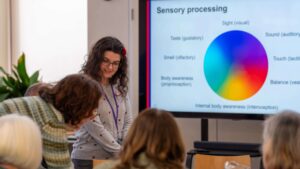 First Response Training (FRT) is a leading national training provider delivering courses in subjects such as health and safety, first aid, fire safety, manual handling, food safety, mental health, health and social care, safeguarding, neurodiversity and more.
They are a Disability Confident Committed Employer and were recently awarded INclusive Worcestershire Leader status. This means they are a fair, equitable and inclusive employer who is proactively and continuously striving for positive change.
The national training provider was one of the first in the country to be approved to offer essential training in line with the Oliver McGowan Mandatory Training on Learning Disability and Autism.
They have since become quality assured to deliver Oliver’s Training through the Quality Assured Care Learning Service (QACLS) from the Department of Health and Social Care and Skills for Care and have trained over 40,000 learners through the delivery of over 1000 Tier 1 and 1000 Tier 2 training sessions.
They now employ over 100 Experts with Lived Experience Co-Trainers, many of whom are autistic. These Expert Co-Trainers are recruited and supported by a specialist team at FRT, who ensures that individual profiles and reasonable adjustments specific to each Expert Co-Trainer are maintained throughout their employment.
FRT’s aim is to empower and educate learners across the country and transform their practice by embracing the lived experience of autistic individuals and those with learning disabilities. Through the collaborative strength of their Trainer Trios – Oliver McGowan Facilitating Trainers and Expert Co-Trainers – they aim to inspire lasting change in how individuals are understood, supported and valued.
What Neurodiversity Celebration Week means to our Expert Co-Trainers
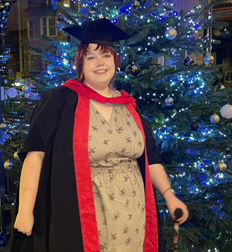
FRT’s Expert Co-Trainers are at the heart of everything they do. Throughout Neurodiversity Celebration Week, they will be sharing what the annual call-to-action means to some of their Autistic Experts with Lived Experience Co-Trainers.
Here are some of their thoughts:
Expert Co-Trainer Hannah says:
“Neurodiversity Celebration Week is, to me, an important opportunity to celebrate how everyone is different, and how we all interact differently with the world around us.
“Neurodivergent people still face many barriers in life, so this week is an important opportunity to showcase some of the many ways that things are being done well to help to include us.
“Finding out I was neurodivergent saved my life. As well as being autistic, I am ADHD, dyslexic and dyspraxic. We still have a long way to go, but it’s important we focus on the positives, as well as the negatives.”
Expert Co-Trainer Wendy says:
“Celebrating National Neurodiversity Week for me, means celebrating the unique differences of individuals – including the different ways people see and navigate through life. It also celebrates the diversity of people’s experiences, and should encourage more awareness of the positives / challenges that neurodivergent folk have and face.”
Ray Moore, an Expert Co-Trainer who also runs a fortnightly Neurodiversity social club in Sunderland, says he believes Neurodiversity Celebration Week is “an opportunity to highlight what contribution neurodiverse people can make to society, and it can highlight the struggles we still face.”

Meanwhile, our Expert Co-Trainer Amelia explains:
“Neurodiversity Celebration Week is important to me as it focuses on people’s strengths and differences. Everyone is unique and we all have something to share with our communities, but sometimes I feel as if neurodivergent people’s struggles are at the forefront of the conversation.
“Working together and learning from people who are different from you is important to help create a united and inclusive community that works for everyone. We’ll never know about things that we don’t experience unless we talk to each other, so this week is a perfect opportunity to learn, grow and try to connect with people you may not have previously, and you may discover a whole new perspective of the world that you hadn’t considered yet.
“Be curious, ask questions (respectfully) and be open minded; no one’s experience of the world is universal, but our humanity links us together; we all just want to be happy, healthy and thrive in our communities. This week gives us the perfect opportunity to have these conversations!”
Koah Fulton, another one of our Expert Co-Trainers, adds that celebrating diversity is “vital,” particularly “in a world that often encourages us to hide who we are and conform to the majority. ” She adds:
“Neurodivergent people are still disadvantaged across key areas like education, healthcare, social care, and the justice system. Too often, we are seen as the problem—when in reality, it is the systems around us that need to change.
“Neurodiversity brings real value. How limited would the world be if we all thought and acted the same way? Embracing different ways of thinking leads to greater creativity, stronger problem-solving, and new ideas. It also fosters empathy, kindness, and a deeper sense of inclusion. Instead of focusing on what is ‘wrong’ with someone, we should recognise and celebrate what makes them different. When we do this, people are more able to fulfil their potential, achieve their goals, and contribute in meaningful, individual ways.
“For me, autism shapes how I experience the world. It helps me think outside the box, push myself to go above and beyond, and care deeply about causes like animal rights and feminism. I have strong skills in logic and numbers, can recognise patterns easily, and notice when things change. I can make people laugh through stand-up comedy, and I can make people think by sharing my lived experience. Autism isn’t a superpower, but it is an important part of who I am. It comes with challenges I navigate every day, but it also gives me a unique perspective.
“Neurodiversity Celebration Week is about shifting the narrative—listening to lived experiences, valuing different minds, and creating a world where people don’t just fit in, but truly belong.”
Keep an eye on our social media for more perspectives from our Autistic Experts with Lived Experience Co-Trainers. They will also be sharing their neurodivergent role models with our community.
Neurodiversity training solutions
FRT have also developed and delivered a number of Neurodiversity training courses, such as Introduction to the Autism Spectrum, ADHD Awareness, Dyslexia Awareness, Sensory Processing Disorder Awareness and SEND Awareness.
They have also previously worked in partnership with clients to develop bespoke training for them in topics such as Adapting Learning for SEND and, SEND and Barriers to Learning.
They are also currently piloting a Neurodiversity training programme for schools which has been co-developed and co-delivered by experts with lived experience.
A trainer from FRT says:
“Whether in schools, universities, workplaces or our communities, we need to focus on fostering environments where everyone can thrive.
“With 15% of the UK population identifying as neurodivergent, businesses must take meaningful steps to provide support, make reasonable adjustments, and educate their workforce.
“At First Response Training, we are committed to inclusion through flexible policies, neurodiversity training, and practical workplace adjustments. We can support our clients to make the same commitment, firstly with training to empower staff with the essential knowledge and skills to support neurodivergent individuals, and then with useful resources to help you continue your journey.”
Download FRT’s Neurodiversity Training Brochure here.
You can also download their free Neurodiversity Training Guide and a guide to creating an inclusive workplace for neurodivergent employees.
For more information on the training that FRT can provide, please call them today on freephone 0800 310 2300 or send an e-mail to info@firstresponsetraining.com.