
Toy giant Mattel have launched their first autistic Barbie in a bid to improve “representation and inclusion,” but the doll has been met with a mixed reaction.
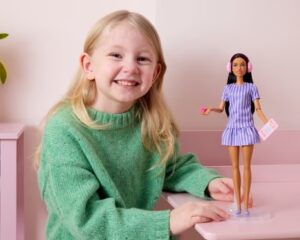
Launched on Monday 12th January 2026, Mattel’s first autistic Barbie was created in collaboration with US charity the Autistic Self Advocacy Network (ASAN) and research included testing reactions to the doll from autistic children and their families.
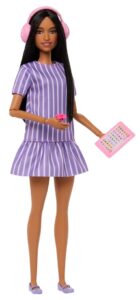
Part of the Barbie Fashionistas line, the doll features eyes which gaze slightly to one side, thereby avoiding direct eye contact, and has fully bendable elbows and wrists to enable stimming movements and hand-flapping to help her process sensory information and express excitement.
Autistic Barbie holds a pink fidget spinner on her finger to reduce stress and wears noise-cancelling headphones to reduce sensory overload. She is also carrying a pink tablet with symbol-based augmentative and alternative communication buttons on its screen to support her communication needs. Her dress is loose-fitting and flowy to minimise fabric-to-skin contact and her shoes are flat to promote stability and ease of movement.
Mattel says the doll is designed to represent some of the ways in which autistic children may experience, process and communicate with the world, and that she has been introduced to enable more children to “see themselves in Barbie” and to encourage all children to play with dolls that more accurately reflect the world and the people around them.
Launch of autistic Barbie a ‘milestone’ for young autistic people
ASAN has heralded the launch as a “milestone” and explained:
“It is so important for young autistic people to see authentic, joyful representations of themselves, and that’s exactly what this doll is.”
The first Barbie doll launched in 1959. While back then, there was very little about the doll that could be described as “inclusive,” Mattel now prides itself on offering the most diverse doll line on the market with 35 different skin tones, 97 hairstyles and 9 body types represented to present a broader view of beauty.
Since 2019, the Barbie Fashionistas line has expanded significantly to feature many dolls with disabilities to improve representation. This includes Barbie and Ken dolls with prosthetic limbs, wheelchairs and hearing aids and dolls with vitiligo.
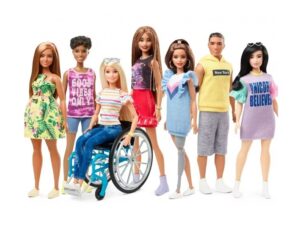 Many dolls have been created in collaboration with relevant charities and communities to ensure authenticity. For instance, the first blind Barbie, which comes with a white cane, was created with the American Foundation for the Blind, and a Barbie with Down’s Syndrome was developed with the National Down Syndrome Society (NDSS).
The recent launch of the new autistic Barbie follows the introduction last year of a Barbie with Type 1 diabetes, featuring a glucose monitor and insulin pump. Mattel partnered with Breakthrough T1D to develop the doll.
Every child deserves to see themselves in play
Mattel says the new more inclusive line aims to build confidence for children with disabilities, while helping all children develop empathy and foster inclusivity.
 Launching the autistic Barbie, the company’s global head of dolls, Jamie Cygielman, said they had “always strived to reflect the world kids see and the possibilities they imagine, and we’re proud to introduce our first autistic Barbie as part of that ongoing work.”
She explains that “every child deserves to see themselves in Barbie,” and added:
“We engaged with the autistic community throughout the design process, always mindful that autism is experienced differently by every individual and is not always visible. The elements of this doll reflect how some people on the spectrum may experience and express the world, and we hope that by partnering with influential voices within the community, Barbie can continue to showcase a broader range of authentic experiences.”
Autism is a neurodiversity which relates to the way an individual experiences, processes and interacts with the world. It encompasses a wide range of traits and experiences, with individuals requiring different levels and types of support.
Recent figures suggest that around 1 in 100 children in the UK have an autism diagnosis, but there may be many more undiagnosed.
Autistic Barbie lets young girls wear differences with pride
 Responding to Mattel’s launch of an autistic Barbie, the Chief Executive of UK charity Ambitious about Autism, Jolanta Lasota, noted that “any Barbie can be reimagined as autistic, because autism doesn’t have a look,” but also acknowledged that “representation is powerful, and Barbie is an iconic toy, so we hope many autistic children feel pride at seeing some of their experiences reflected in this new doll.”
She also added:
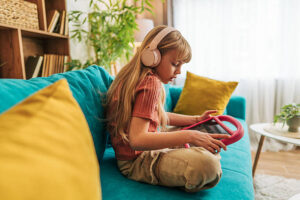
“We know some autistic young people are reluctant to use supports such as ear defenders and stim toys at school for fear of standing out, so the more we can normalise these types of visible markers the better.
“With girls three times less likely than boys to be diagnosed with autism, this toy also shines a light on the experiences of autistic girls, who often slip under the radar.”
Content creator and author Ellie Middleton, who has autism and ADHD and founded an online community for neurodivergent people, has also welcomed the launch, saying the new autistic Barbie “is showing young girls that it is ok to be autistic, it is ok to be different, and it is ok to wear those differences with pride.”
Coproduction matters for representation
Posting on social media, Paula McGowan OBE said of the launch:
“I welcome that Mattel worked with autistic people to create an autistic Barbie. Autism presents differently for everyone. Coproduction matters if representation is to be meaningful not tokenistic.”
 Paula McGowan is an advocate and campaigner for the autism and learning disability communities. She helped to change the law around autism and learning disability training for healthcare professionals and worked with NHS England to develop the Oliver McGowan Mandatory Training Framework on Learning Disability and Autism.
The landmark training programme is named after her son, Oliver, who died aged 18 when medical staff failed to understand his autism and did not listen to his input about his care. The aim of the statutory training is to ensure that the voices of those being treated are heard and respected, and their experiences and needs are understood.
For Paula, the key to the training is that it was co-developed with, and continues to be co-delivered by, autistic people and people with learning disabilities.
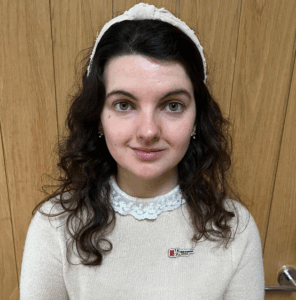
First Response Training (FRT) delivers Oliver’s Training to numerous NHS Trusts and social care providers throughout the UK. They employ over 100 Experts with Lived Experience Co-Trainers to co-deliver this important programme.
One of their Autistic Experts with Lived Experience Co-Trainers, Laura Williams, has shared her perspective on Mattel’s recent launch, saying that she believes the first-ever autistic Barbie doll highlights the importance of representation and neurodiversity.
Laura explains:
“As an autistic woman who was diagnosed with autism at the age of five, I am more than delighted about the first autistic Barbie doll from Mattel that was designed and produced in a partnership with the Autistic Self-Advocacy Network.
“This is very much like all the previous Barbie Fashionistas dolls, including the two Down syndrome dolls, the one who wears a hearing aid, a blind doll with her walking stick and the one with Type 1 diabetes, that have not only educated young girls about certain disabilities and conditions but also help part of the target audience who have them feel like they can be accepted and potentially empowered in today’s society. After all, the slogan of the Barbie franchise is “You Can Be Anything”.
“Without further ado, let us discuss the importance of the new doll as a representation of some autistic girls in the notable diversity of Barbie dolls today and how it can help young children understand what it is like to be autistic, leading to empathy without falling for misinformation.”
Meanwhile, leading charity the National Autistic Society has also responded to Mattel’s recent launch, cautioning that it is “important to remember autistic people can be very different from each other.”
It’s Managing Director of National Programmes, Peter Watt, agreed, however, that “more depictions of autism is key to understanding and autism acceptance.”
He added:
“It’s really important that these representations are authentic and based on extensive consultation with autistic people, and we’re pleased Mattel involved the autistic community in the development of this doll.”
Ultimately, he said, better public understanding of autism could help to “transform hundreds of thousands of autistic people’s lives.”
Parents from the autism community respond to autistic Barbie
 Tonya, a Colchester mum whose 5-year-old daughter Penelope was included in Mattel’s research for the doll, told the BBC that the introduction of the new Barbie had been “an overwhelmingly positive experience,” for her autistic child.
Explaining that Penelope often uses ear defenders, she said “to see that on a doll really made her feel special.”
However, another mother expressed concerns that the new autistic Barbie doll only serves to feed harmful stereotypes and presents a limited view of autism.
Expressing her frustration in an article for Grazia, she explains that “despite all the awareness raising of the last few years, the world can still be pretty clueless and unintentionally unkind when it comes to the complexities of autism […]. Autism presents itself differently from person to person. And research has found this is particularly true among women and girls, who tend to display autistic behaviour differently to males, and are more likely to ‘mask’ (pick up on how others are behaving in social situations and try to mimic them).”
She adds:
“And a doll that depicts an autistic woman wearing headphones, loose clothing, and ear defenders, who is gazing awkwardly and hand flapping, feeds all the stereotypes that parents like me try to debunk.”
Many parents within the community have responded similarly, arguing that autism is not a ‘one-size-fits-all’ and does not have a specific ‘look’.
Meanwhile, others have argued that the doll will help to raise awareness and hopefully encourage inclusion and acceptance, with others saying they are excited to get the new Barbie for their child.
The jury is still out on autistic Barbie
 No single doll can be expected to represent the experiences of all autistic people, after all. But does that mean they shouldn’t make any autistic dolls at all?
Autism campaigner Anna Kennedy OBE is unsure.
Anna spoke to Nick Ferrari on LBC Radio yesterday amid the launch of Mattel’s new autistic Barbie. Summarising her thoughts on social media later that day, she commented:
“The autistic Barbie doesn’t represent all autistic children or the wide range of their experiences and behaviours. Autism is a spectrum, and no single doll can capture that diversity. However, a positive is that it gets people talking about autism and inclusion, which can help raise awareness and understanding.
“Would I buy one if I had an autistic daughter? I am not sure…”
Understanding autism and neurodiversity
First Response Training (FRT) provides a range of training on autism and other neurodivergences.
They were one of the first training providers in the country to be approved to offer essential training in line with the Oliver McGowan Mandatory Training on Learning Disability and Autism.
They are quality assured to deliver Oliver’s Training through the Quality Assured Care Learning Service from the Department of Health and Social Care and Skills for Care.
 The national training provider aims to empower and educate staff to transform their practice by embracing the lived experiences of autistic individuals and those with learning disabilities. Through the collaborative strength of their trios—facilitating trainers and experts with lived experience — FRT aims to inspire lasting change in how individuals are understood, supported, and valued.
If you want to learn more about the Oliver McGowan Mandatory Training Framework, you can book a free consultation with their Project Lead, Perry Leeks, to find out all about the programme and how FRT can address the needs of your organisation and staff.
FRT are hosting a series of open, public Tier 2 courses in London, Manchester and Birmingham in the coming months. You can book a space on any of these courses online now. They also offer open Tier 1 webinar sessions.
FRT have also developed a free-to-download quick guide to the new Oliver McGowan draft code of practice.
This guide explains what the new code of practice means for health and social care providers, how to stay current, and how to meet new legal duties.
You can also download FRT’s free Oliver McGowan Mandatory Training brochure.
Providing an alternative training solution
 To offer health and care providers flexibility and choice, FRT have also developed their own Tier 2 Mandatory Autism and Learning Disabilities Training package.
Fully mapped to the core capabilities framework, Oliver McGowan Mandatory Training Code of Practice and externally accredited, this package offers providers an efficient, affordable alternative solution.
Please note that, while fully interactive, this webinar-based training solution does not meet the code of practice’s requirement for the training to be ‘face-to-face’.
The training is designed to meet statutory standards and equip health and social care staff to deliver more empathetic, person-centred support.
You can learn more about how FRT developed this training package here.
For further information on other types of neurodiversity training, visit their webpage or download the brochure.
A trainer at FRT explains:
“When it comes to providing real, transformative care and support for people with autism, it’s about working to truly understand the lived realities of autistic individuals. An increase in awareness, knowledge and understanding can hopefully help to improve the lives of individuals and achieve wider acceptance.”
You can contact FRT via freephone 0800 310 2300, send an e-mail to info@firstresponsetraining.com or submit an online enquiry.