Thursday 2nd April is World Autism Day 2026; a day to celebrate the strengths of autistic people and promote neuroinclusivity across health, education, workplace, sports and all sectors of society.
 Acting as a kick off point for World Autism Acceptance Month, and backed by the World Health Organisation (WHO), World Autism Day unites families and communities across the globe as they recognise the dignity and worth of all autistic people and advocate for policies that support and include them.
Statistics show that around 1 in 127 people have an autism diagnosis globally. The WHO says autism is among the top 10 brain health conditions contributing to health loss globally.
World Autism Day addresses key challenges for global autistic community
 World Autism Day, also known as World Autism Awareness Day or World Autism Acceptance Day, aims to address the challenges facing millions of autistic people across the world. These include:
- Stigma, stereotyping and discrimination
- Barriers to participation in education, the workforce and wider community
- Difficulty accessing timely, quality healthcare and support services
The WHO explains that addressing these issues “requires sustained action and greater investment in inclusive policies and services that uphold the rights of autistic people.”
They highlight evidence which shows that autistic people can thrive with early diagnosis, inclusive education and nurturing care in families and communities, with significantly improved health and wellbeing outcomes.
The WHO seeks to increase “government commitment to improve quality of life for autistic people and strengthen data informed decision-making; providing guidance on inclusive policies and actions plans within broader health, mental health, brain health and disability frameworks; and strengthening community-based services.”
They also aim to promote inclusive environments and provide support for autistic people and their caregivers.
A message for World Autism Day
The Secretary-General of the United Nations, António Guterres, said in a special message that World Autism Day is a time to “celebrate the inherent dignity and worth of all autistic people.”
He added:
“The Convention on the Rights of Persons with Disabilities makes it clear that all of us, regardless of neurodiversity or other differences, are members of the human family, entitled to enjoy the entire range of human rights.
“Yet, in turbulent times, harmful stigmas are resurfacing and eroding the progress we have made towards inclusion and equality.
“Like anyone else, autistic people should be able to shape their own lives – and help to shape our shared future. They bring talents, perspectives and contributions that make the world a better place.
“Through equal education, fair employment, and accessible health systems, we can ensure that autistic people have the opportunities they deserve to participate and thrive.
“Embracing diversity strengthens us all. Today and every day, let us reaffirm our common humanity and renew our commitment to a more inclusive world for all.”
Kicking off World Autism Acceptance Month
 In the UK, the National Autistic Society marks World Autism Acceptance Month throughout April as an opportunity to “raise awareness, acceptance, and create a society where autistic people are supported and understood.”
They help schools, workplaces, organisations and communities to take part in World Autism Acceptance Month and, indeed, World Autism Day.
The leading autism charity says that improving outcomes for autistic people is “about how your show up, whether you’re supporting your autistic colleagues, students, or family members, your actions can help create an inclusive and accepting world.”
They provide free resources, lesson plans and activities for schools, additional resources and a free webinar for workplaces and help people fundraise at home for World Autism Acceptance Month.
They run awareness and fundraising activities throughout April such as a Spectrum Colour Walk and 5K and 10K challenges.
It’s how you show up that counts this World Autism Day
 The National Autistic Society has taken this a step further for 2026 with their special public awareness campaign, It’s How You Show Up, which aims to educate people on the simple changes they can make to better support autistic people and help them to thrive at home, school, work and in public places.
The campaign has been informed by the Society’s surveys and research, which highlight a “significant gap in understanding of autism” and the ways people can support autistic people.
The National Autistic Society explains:
“Showing up can look like taking little steps to understand someone’s experience of the world. Allowing time for them to process or space for them to regulate. Shifting your expectations and making it clear that, that’s OK. Advocating for autistic colleagues in the workplace and the world. There are so many simple, everyday ways you can make a huge difference while helping to build a kinder, more supportive world for everyone.”
They have provided real-life examples of what it means to show up for autistic people on their website and have also created a pledge wall as a space to commit to positive actions, including learning more about autism or creating inclusive spaces.
Final day of the Walk for Autism
 The Walk for Autism fundraising challenge, led by the Autism Initiatives Group, reaches its conclusion today, on World Autism Day.
The Walk for Autism challenge asks individuals or teams to walk 10,000 steps per day for 8 days from 26th March until 2nd April – World Autism Acceptance Day.
As well as raising much-needed funds to help the Autism Initiatives Group provide support and opportunities for autistic people and their families and carers, the Walk for Autism challenge is also designed to help increase autism acceptance and understanding.
Participants are encouraged to walk at their own pace, in their own time, to achieve their personal step target, with organisers highlighting how walking can help to improve physical health, boost wellbeing and reduce stress.
A team of colleagues from First Response Training (FRT) have been taking part in the Walk for Autism. They hope to end the challenge on a high today with over 1 million steps completed by the team as a collective, and hope to raise over £1000 for autism research and support.
You can follow along with the FRT team’s progress on social media and can sponsor them online.
Becky Cropper, Oliver McGowan Mandatory Training Lead at FRT, is leading the team. She said:
“This money goes to a wonderful cause and will help support people who need it. I am really excited to take part and really excited to see what our team can do!”
Sponsor the FRT team to Walk for Autism here.
Delivering valuable training in autism and neurodiversity
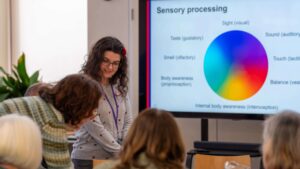 The national training provider was one of the first in the country to be approved to offer essential training in line with the Oliver McGowan Mandatory Training on Learning Disability and Autism.
They have since become quality assured to deliver Oliver’s Training through the Quality Assured Care Learning Service from the Department of Health and Social Care and Skills for Care and have trained over 40,000 learners through the delivery of over 1000 Tier 1 and 1000 Tier 2 training sessions.
They now employ over 100 Experts with Lived Experience Co-Trainers, many of whom are autistic.
FRT’s aim is to empower and educate learners across the country and transform their practice by embracing the lived experience of autistic individuals and those with learning disabilities. Through the collaborative strength of their Trainer Trios – Oliver McGowan Facilitating Trainers and Expert Co-Trainers – they aim to inspire lasting change in how individuals are understood, supported and valued.
Laura Amy Williams, Autistic Expert with Lived Experience at FRT, says:
“It gives me a lot of reassurance to know there are so many people who want to understand autism and autistic people. As an expert with lived experience, I feel I can simply be myself and share my story.”
FRT deliver over 7,000 courses each year in the fields of health and safety, first aid, fire safety, food safety, mental health, health and social care and other special focus topics.
You can contact FRT via freephone 0800 310 2300, send an e-mail to info@firstresponsetraining.com or submit an online enquiry.