
The government published the 2026 Schools Whitepaper last month, promising that it will transform “life chances for disadvantaged children and children with SEND.”
 The Every Child Achieving and Thriving whitepaper, published 23rd February 2026, sets out generational reforms to the schools and special educational needs and disabilities (SEND) systems in England to help “improve the lives of all children and young people.”
The government has pledged to “cut the link between background and success” with plans to reform deprivation funding for schools to help halve the gap in outcomes between poorer children and their peers.
The broad aims of the whitepaper, described as a “blueprint for opportunity,” include:
- Shifting children’s school experience from narrow to broad
- Ensuring those who have been sidelined are included
- Taking children and communities from withdrawn to engaging with schools
It is supported by a delivery plan to recruit 6,500 additional teachers.
Schools whitepaper sets out plans to improve local outcomes
 The government highlights figures which show that, currently, only 44% of poorer children achieve a pass at grade 4 or above in their maths and English GCSEs, compared to more than 70% of children who do not receive free school meals.
They propose to use household income rather than the receipt of free school meals as an indicator and determine funding by a stepped model to ultimately deliver greater levels of investment to schools that are supporting the poorest children.
The whitepaper has taken cues from the London Challenge in the early 2000s, a programme which the government says transformed educational outcomes across England’s capital city “through collaboration and targeted intervention,” as well as pre-existing examples of local innovation in the school system. It has defined two new area-based challenges based on these: Mission North East and Mission Coastal.
These schemes are designed to improve outcomes for pupils locally, including white working-class children, by uniting schools, parents and communities to develop innovative strategies to deliver sustained improvement. They will then be used as a blueprint for national transformation.
Schools whitepaper a ‘golden opportunity’ to close the gap
 The government says reforms to the school system will stand alongside action to lift the two child benefit cap, put a family hub in every local council and provide 30 hours of free childcare to give every child the best start in life and ease pressure on families.
Education Secretary Bridget Phillipson said the whitepaper represented a “golden opportunity” to close the achievement gap and added:
“Our schools have made great strides in recent decades. Yet for too long, many children in our country have been let down by a one-size fits all system, denied opportunity because they’re poor or because they have additional needs.
“Our schools whitepaper presents the blueprint for opportunity for the next generation, with an education system that truly serves every child, whatever their needs and wherever in the country they grow up.”
The Schools Whitepaper also includes:
- A new attendance target to recover 20 million school days pre year by the end of the 2028-29 academic year compared to 2023-24, which equates to 100,000 more pupils attending school full-time and would be the fastest rate of improvement in over a decade
- New retention incentives of up to £15,000 for newly appointed headteachers to work for sustained periods in parts of the country with greatest need
- A boost in maternity pay for school leaders, teachers and support staff to support more women to stay within the profession
- Plans for new ‘school profiles’ which would act as a ‘one-stop-shop’ for parents, providing key information about attendance, attainment and enrichment
- A commitment to develop minimum expectations for schools around engagement with parents. These may include timely communication and high-quality transition from primary to secondary
- A potential new progress measure to better capture the progress and achievements of children who start secondary school significantly behind their peers
Widescale reforms to SEND system set out in schools whitepaper
 There are wider reforms set out to the SEND system, with plans for more children to receive better support, earlier, closer and, crucially for many families, “without a fight.”
The government describes a “support-first” approach with more training to ensure every teacher is a teacher of children with SEND.
Writing for Children and Young People Now, Tracy Cockayne, a Senco and Strategic Lead for SEND at a special school, says the whitepaper “presents an ambitious vision” but argues that it is underfunded, saying: “When we look at the financial maths, the gap between ambition and reality is stark.”
Her concerns were echoed by the Education Policy Officer at Disability Rights UK, who said:
“The Government has argued for too long that ‘the SEND system is financially unsustainable’ for us to believe that these reforms are anything but a cost-cutting exercise. Especially when these reforms are accompanied by such inadequate investment.”
However, the British Dyslexia Association said in a statement that it welcomed the reforms, adding:
“We support the vision for schools that are more inclusive by design, and which recognise that SEND support and provision must be at the very heart of education, not bolted on as an afterthought.
“We are particularly encouraged by the focus on inclusion in mainstream classrooms. When teachers are supported to recognise and respond to commonly occurring needs such as dyslexia, children do not have to struggle in silence or fall behind before help arrives. The additional funding should help put inclusion at the heart of every school and enable all schools to fund interventions like small group support, or support staff to identify and support dyslexic challenges by adapting teaching styles, so that every pupil can thrive.
“The additional funding is positive, but funding alone will not change school culture, so it is good to see even more focus on training and upskilling classroom teachers and support staff in mainstream settings, supported by easier access to specialists.”
They called for a national dyslexia strategy and confirmed their intention to respond to the consultation.
“The long-anticipated schools white paper seeks to address a range of issues, and it will take time to fully understand its implications. A renewed focus on pupils not currently well-served by the school system is welcome, particularly given the significant attainment gaps we see for specific groups. Our research shows that pupils in sustained low-income households typically leave school the equivalent of two years’ learning behind their peers; we have argued for targeted funding for some time. These pupils will also benefit from a focus on enrichment activities that support soft skills, health, cognitive development, and new friendships.
“The proposed SEND reforms will inevitably draw the most attention given the system’s significant challenges. If adequately resourced, the introduction of Experts at Hand will give schools better access to specialist support, while individual support plans will aid transparency. However, parents will need reassurance that tiered support and EHCP reforms do not simply become a new set of hoops to jump through.
“Ultimately, the challenges this white paper seeks to address cannot be met by schools alone. They require joined-up thinking and a coordinated approach across all services.”
Shadow Education Secretary Laura Trott criticised the government’s push for a trust-led system, describing the proposals as “inconsistent” with other government policies regarding academy trusts and with the, at the time, pending Children’s Wellbeing and Schools Bill.
Schools whitepaper identifies need for better training
 One thing that could help ensure better understanding, support and appropriate provision for many children and young people with special educational needs and disabilities is tailored training on neurodiversity, learning disabilities and autism.
The Oliver McGowan Mandatory Training Framework on Learning Disability and Autism is having a significant, valuable impact in healthcare, with senior doctors describing the training programme as potentially life-saving.
The co-delivery approach adopted by Oliver’s Training, which sees an experienced Facilitating Trainer co-delivering the programme with two Expert Co-Trainers – one with lived experience of a learning disability, and another with lived experience of autism – could also be beneficial in education.
Oliver’s mother, Paula McGowan, has been campaigning for this training to be made mandatory for the education sector for some time.
Paula’s hard-fought campaign for better training in learning disabilities and autism for healthcare staff culminated in the passing of the Health and Care Act 2022. This piece of legislation created the statutory requirement for all healthcare staff to undergo training in learning disabilities and autism, with the Oliver McGowan Mandatory Training framework being identified as the government’s preferred and recommended training route.
In 2023, she launched a petition calling for all staff in education settings to also be trained on learning disabilities and autism.
Successful delivery of the Oliver McGowan Mandatory Training
 First Response Training (FRT) was one of the first training providers in the country to be approved to offer essential training in line with the Oliver McGowan Mandatory Training on Learning Disability and Autism.
The national training provider aims to empower and educate staff to transform their practice by embracing the lived experiences of autistic individuals and those with learning disabilities. Through the collaborative strength of their trios—facilitating trainers and experts with lived experience — FRT aims to inspire lasting change in how individuals are understood, supported, and valued.
Leon Williams, Lead Director at FRT, says:
“We must acknowledge the incredible work of Paula McGowan, whose tireless campaigning has led to this training becoming a statutory requirement for all health and social care staff. Through the tragic loss of her son, Oliver, meaningful change is being made to improve the quality and standards within health and social care.”
One of FRT’s valued Expert with Lived Experience Co-Trainers, Laura Amy Williams, adds:
“It gives me a lot of reassurance to know there are so many people who want to understand autism and autistic people. As an expert with lived experience, I feel I can simply be myself and share my story.”
FRT are hosting a series of open, public Tier 2 courses in London, Manchester and Birmingham in the coming months. You can book a space on any of these courses online now.
FRT have also developed a free-to-download quick guide to the new Oliver McGowan draft code of practice.
This guide explains what the new code of practice means for health and social care providers, how to stay current, and how to meet new legal duties.
You can also download FRT’s free Oliver McGowan Mandatory Training brochure.
Neurodiversity and adaptive practice for schools
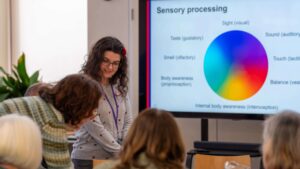 FRT have recently co-developed a focused training session on Neurodiversity and Adaptive Practice for schools, which will be co-delivered with Experts with Lived Experience and which they are currently piloting with the Tapscott Learning Trust, an award-winning trust based in London.
The 3-hour training session aims to inspire education staff to make learning more accessible for neurodiverse pupils by embedding reasonable adjustments through adaptive, inclusive practice.
Learning outcomes include:
- Explain neurodiversity and common co-occurring profiles
- Recognise early indicators of dysregulation and unmet need
- Understand why autism and other neurodiverse conditions are described as
- Invisible
- Reflect on your own values, beliefs and practice
- Recognise potential differences, strengths and challenges for neurodiverse pupils
- Identify reasonable adjustments and ways to adapt your practice
- Record the impact
Perry Leeks, Project Director at FRT, says:
“We were so excited and privileged to collaborate with members of the neurodiverse community to develop a special programme for the education sector that specifically addresses a very real need, meets key criteria outlined in the Schools whitepaper, and helps teachers reflect on and enhance their practice and the support they offer.”
Download an information leaflet to learn more about the taster sessions FRT are hosting with the Tapscott Learning Trust.
For further information on other types of neurodiversity training, visit FRT’s webpage or download the brochure.
You can contact FRT via freephone 0800 310 2300, send an e-mail to info@firstresponsetraining.com or submit an online enquiry.