
Experts are considering the introduction of a new autism diagnosis to help ensure that people with the highest support needs are provided with targeted services, focused research and funding.
 A panel of international experts, commissioned by the Lancet, has proposed the introduction of a new diagnostic category of “profound autism”.
This new diagnosis would apply to autistic children aged 8 and over who have little to no functional language, an IQ below 50 and require 24-hour care and adult supervision.
Researchers say this new diagnosis category could help improve life outcomes and support governments and service providers to plan more effectively for individuals with the most complex needs, who are often under-represented in autism research.
However, in the article, The Lancet Commission on the future of care and clinical research in autism, the authors caution that change will be difficult and “will depend on investments in science focused on practical clinical issues, and on social and service systems that acknowledge the potential for change and growth as well as the varied, complex needs of the autistic individuals and their families whose lives could be changed with such an effort.”
New autism diagnosis could help overlooked group
 Autism is estimated to affect around 78 million people worldwide.
Awareness and understanding of the neurological difference has been steadily improving over recent years, but there are still improvements that can be made in care and support, with some individuals with the most complex needs often being overlooked by services.
The Lancet research team reviewed a new Australian study which looked at how the category of profound autism may work in practice.
Following an analysis of 513 children who had been assessed for developmental conditions over 5 years, it found that almost a quarter (24%) of autistic children met, or were likely to meet, the criteria for profound autism. This was in line with international estimates.
Children in this group were more likely to display behaviours that posed safety risks, with almost half having attempted to run away from carers, compared to around a third of other autistic children.
Challenges in implementing new autism diagnosis
 Researchers stressed, however, that significant challenges were also identified among the children who did not meet the proposed criteria for profound autism. For example, a fifth engaged in self-injury and more than 1 in 3 exhibited aggressive behaviour.
In addition, the criteria for profound autism did not always align with existing diagnostic levels which are used to establish appropriate support and funding.
Some children who met the criteria had been previously classified at lower support levels, while others receiving the highest level of support did not necessarily meet the new proposed definition, and this could jeopardise support and funding for them.
Researchers said this could complicate funding decisions unless the proposed criteria for profound autism were adapted and carefully introduced.
The proposed age threshold of 8 also presents issues. It was suggested by researchers because, by age 8, children’s cognitive and communication abilities are considered more stable. But the key concern is that most children are diagnosed with autism before this age, meaning the introduction of a new diagnosis category may force families to repeat assessments and add pressure to already overstretched services.
Following concerns that a new category of profound autism places too much emphasis on the challenges that individuals experience, they also caution that it would need to be applied carefully and communicated in inclusive language that recognises each child’s strengths as well as their challenges.
Profound autism diagnosis could provide clearer support
 However, the authors maintain that a new diagnosis of profound autism could still provide a clearer way to identify individuals with the greatest support needs.
If the category were included in future clinical guidelines, researchers believe it could help services improve planning and resources, thereby reducing the risk that children with the most complex needs “fall through the cracks.”
They also provided practical advice for parents who believe their child is autistic and requires a high level of support. This includes:
- Clearly communicate any safety concerns
- Highlight behaviours and challenges that affect your child’s daily life
- Seek guidance for your whole family
- Connect with other carers
- Prioritise safety planning with clinicians
Autism training and support
First Response Training (FRT) was one of the first training providers in the country to be approved to offer essential training in line with the Oliver McGowan Mandatory Training on Learning Disability and Autism.
 They are quality assured to deliver Oliver’s Training through the Quality Assured Care Learning Service from the Department of Health and Social Care and Skills for Care.
The national training provider aims to empower and educate staff to transform their practice by embracing the lived experiences of autistic individuals and those with learning disabilities. Through the collaborative strength of their trios—facilitating trainers and experts with lived experience — FRT aims to inspire lasting change in how individuals are understood, supported, and valued.
If you want to learn more about the Oliver McGowan Mandatory Training Framework, you can book a free consultation with their Project Lead, Perry Leeks, to find out all about the programme and how FRT can address the needs of your organisation and staff.
FRT are hosting a series of open, public Tier 2 courses in London, Manchester and Birmingham in the coming months. You can book a space on any of these courses online now. They also offer open Tier 1 webinar sessions.
FRT have also developed a free-to-download quick guide to the new Oliver McGowan draft code of practice.
This guide explains what the new code of practice means for health and social care providers, how to stay current, and how to meet new legal duties.
You can also download FRT’s free Oliver McGowan Mandatory Training brochure.
Providing an alternative training solution
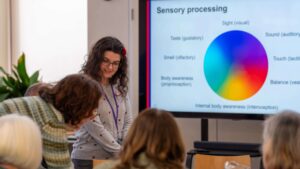 To offer health and care providers flexibility and choice, FRT have also developed their own Tier 2 Mandatory Autism and Learning Disabilities Training package.
Fully mapped to the core capabilities framework, Oliver McGowan Mandatory Training Code of Practice and externally accredited, this package offers providers an efficient, affordable alternative solution.
Please note that, while fully interactive, this webinar-based training solution does not meet the code of practice’s requirement for the training to be ‘face-to-face’.
The training is designed to meet statutory standards and equip health and social care staff to deliver more empathetic, person-centred support.
A trainer at FRT explains:
“This isn’t just about compliance. It’s a chance to improve outcomes, reduce bias, and truly understand the lived realities of autistic individuals and people with learning disabilities, helping to improve care and support and prevent avoidable deaths.”
You can learn more about how FRT developed this training package here.
For further information on other types of neurodiversity training, visit their webpage or download the brochure.
You can contact FRT via freephone 0800 310 2300, send an e-mail to info@firstresponsetraining.com or submit an online enquiry.